
Titin Protein Full Name (189,819 Letters) Pronunciation & PDF
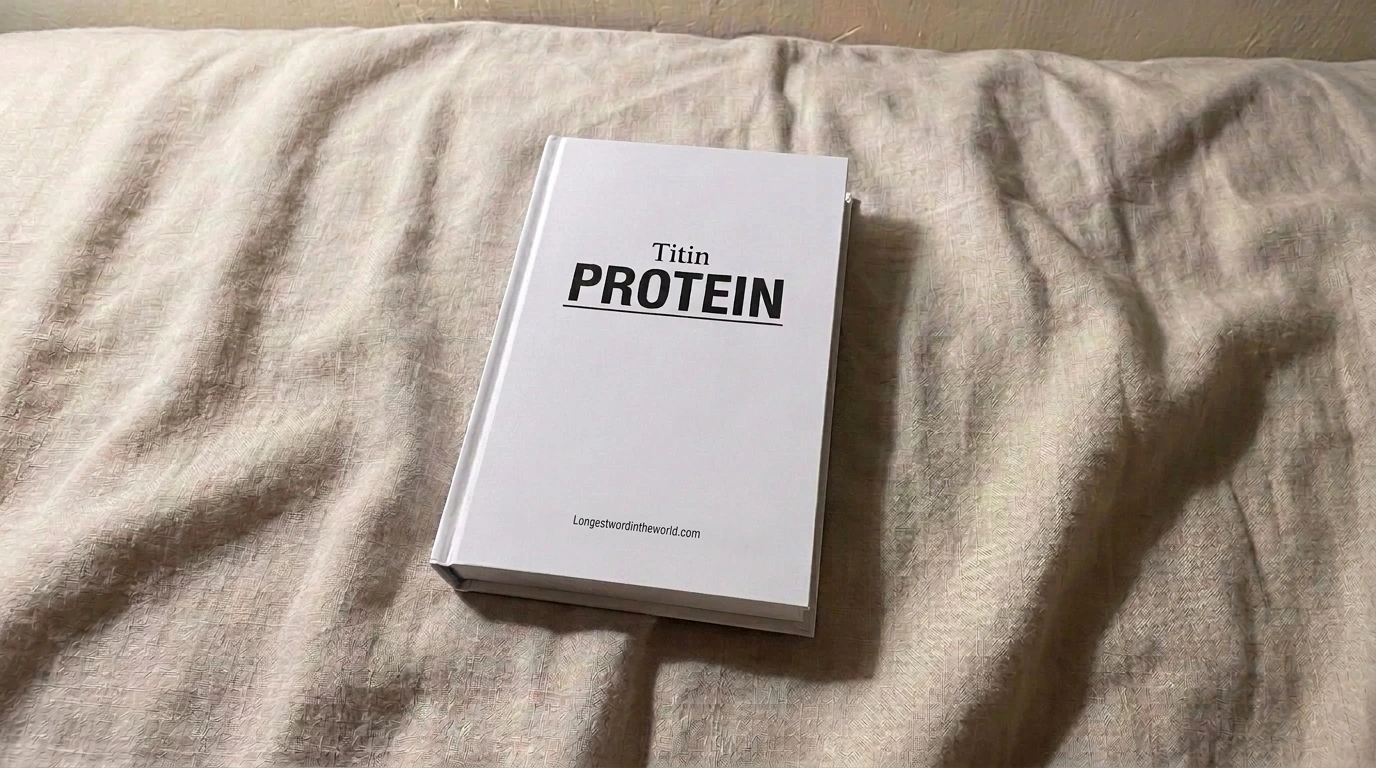
Titin (or connectin) is found in muscle tissue, where it acts like a molecular spring, giving your muscles their passive elasticity. Our bodies contain lots of protein, with titin being the largest. It’s not unusual, but its full name surely is!
Titin’s chemical name has 189,819 letters; here’s a glimpse: methionylthreonylthreonylglutaminylarginyltyrosylglutamylserylleucylphenylalanylalanyl…. It goes on like that for 50+ pages of pure text and is the longest word in the world that takes 3+ hours to say. That also makes it the longest word in the English language, at least if you count technical terms, though as you’ll see below, no dictionary does.
While pronouncing titin’s full word is doable, hardly anyone does. This man actually blew three and a half hours pronouncing the word out loud.
Also, we’ve rounded up titin protein’s full name in a PDF; check it out here, and yes, you can copy-paste the full word right from there.
Why is Titin’s Chemical Name So Lengthy
In chemical naming, a protein’s name must describe every single amino acid in its structure, in order. Titin has 244 protein domains and 26,926 amino acids, causing the name to stretch on for so long.
Titin’s 189,819-letter chemical name comes from applying systematic IUPAC nomenclature rules to list every single amino acid in its precise sequence. This way, any protein or molecule can generate a heck of a long name, since the name is just a formula written in words.
In fact, and surprisingly, DNA molecules can leave titin in the dust, meaning a chemical name longer than titin’s is quite possible. Naming a full strand of human DNA this way could go beyond a billion letters.
Is Titin Protein’s Chemical Name Really the Longest Word in the World?
Yes, and no—depending on what you mean. If you, like most people who Google the longest word in the world, don’t care whether it has a dictionary entry, titin’s full name is the answer, since it’s technically the longest string of letters ever used to name something. But if you mean the real longest word with a dictionary entry, that’s pneumonoultramicroscopicsilicovolcanoconiosis, at 45 letters. Titin’s name is filed under “technically the longest string of letters,” not “the longest word.”
Why Titin’s Full Name Is Not in Dictionaries
Its overwhelming length of 189,819 letters drops it out of dictionaries—yes, titin’s chemical name never even made it into a chemistry dictionary, let alone an English one. Most linguists don’t even take it as a real word, nor do we, because it actually isn’t a lexical word, just an ultra-technical chemical name. That is to say, it’s just a rule-based string of all 26,926 amino acid names, more like a serial number than actual language. And that’s reason enough for dictionaries to pass on it.
Dictionaries exist for words people actually use in everyday talk, literature, or professional work—and titin’s name checks none of those boxes. Biology, chemistry, and even scientists just stick to the shorthand “titin” in practice.
And if dictionaries started accepting titin protein’s full name, they’d have to let in every chemical formula ever written out—a losing battle no dictionary wants to fight—with zero benefit to anyone using the dictionary. This clarifies why it’s left out.
Facts You Must Know About Titin’s 189,819-Letter Word
This giant word has 13 variants, known as isoforms.
People often mistakenly pair the 189,819-letter word with the 34,350-amino-acid canonical version, but the math doesn’t match. It actually spells out the sequence for titin’s isoform 3 (the small cardiac N2-B form), which has 26,926 amino acids.
The 189,819-letter word is the most famous, but titin’s other isoforms have many more amino acids, creating an even longer string of letters (up to 252,176).
FAQs
Wrapping Things Up
Titin’s chemical name is a record-holder in one narrow sense: sheer letter count. No one coined it to communicate anything, and no dictionary, chemistry or otherwise, has ever included it. It’s a formula, not a word, and lexicographers agree on that.
From now on, when someone brings up titin’s 189,819 letters, you’ll know why it’s impressive, but not the “word” they think it is.